Keith Vertrees
I'm the co-founder and CTO of Synthspec. I've had a lot of weird jobs building data and AI products, going back to IBM Watson.
Synthspec
Co-Founder & CTO2025–present
We turn commercial lighting plans and fixture schedules into review-ready takeoffs in minutes, so distributors can bid jobs they used to pass up.
Every architect invents their own symbols, and half a dozen companies end up counting the same building plans by hand. It's a great AI problem because validation is binary: the counts are either right or wrong.
Estimators at our design partners run it on live bids, and we check every count against theirs.
If you run estimating at a lighting distributor, send me your worst drawing set.
IntegratedIQ2023–present
Independent consulting after Shift, mostly working with companies that promised their customers AI and found out it takes more than bolting on a chatbot. Stuck with it until the right problem came along.
Shift
SVP, Chief Product & Technology Officer2021–2023
Shift sold used cars online. I joined as a product manager, ran product a few months later, and took over engineering a year after that.
We replaced custom-built systems with off-the-shelf software. Tech spend dropped 80%, AWS hosting fell about 70% while traffic grew, and upper-funnel conversion rose 30%.
I also led technical due diligence and integration for the Fair and CarLotz acquisitions, then rode the SPAC into the ground at the end of 2023 like most of them did.
DraftKingsAssociate Director of Product Management, 2020–2021
Took a break from AI to do big data work. All of DraftKings' transaction data (every bet, poker hand, and roulette spin) sat in Microsoft SQL Server, and it wasn't going to survive the next Super Bowl.
I had under a year to move them to Snowflake. We shipped it on time and migrated over a hundred analysts.
IBM
Lead AI Solutions Architect2015–2017
IBM had a giant box that beat Ken Jennings at Jeopardy and wanted to monetize it across boring enterprise middleware: marketing automation, order management, storefronts, and pricing. My job was figuring out what Watson could actually do in those products.
This was pre-transformer NLP and the first wave of bolting a chatbot onto everything. If you drop the need for AI to be visible, you can solve much better problems with your data, even when product and marketing want something flashy.
It's easy to crank out solutions looking for a problem and let the wrong incentives wreck a product. I spent plenty of time arguing over using the Watson brand when plain ML was the better answer.
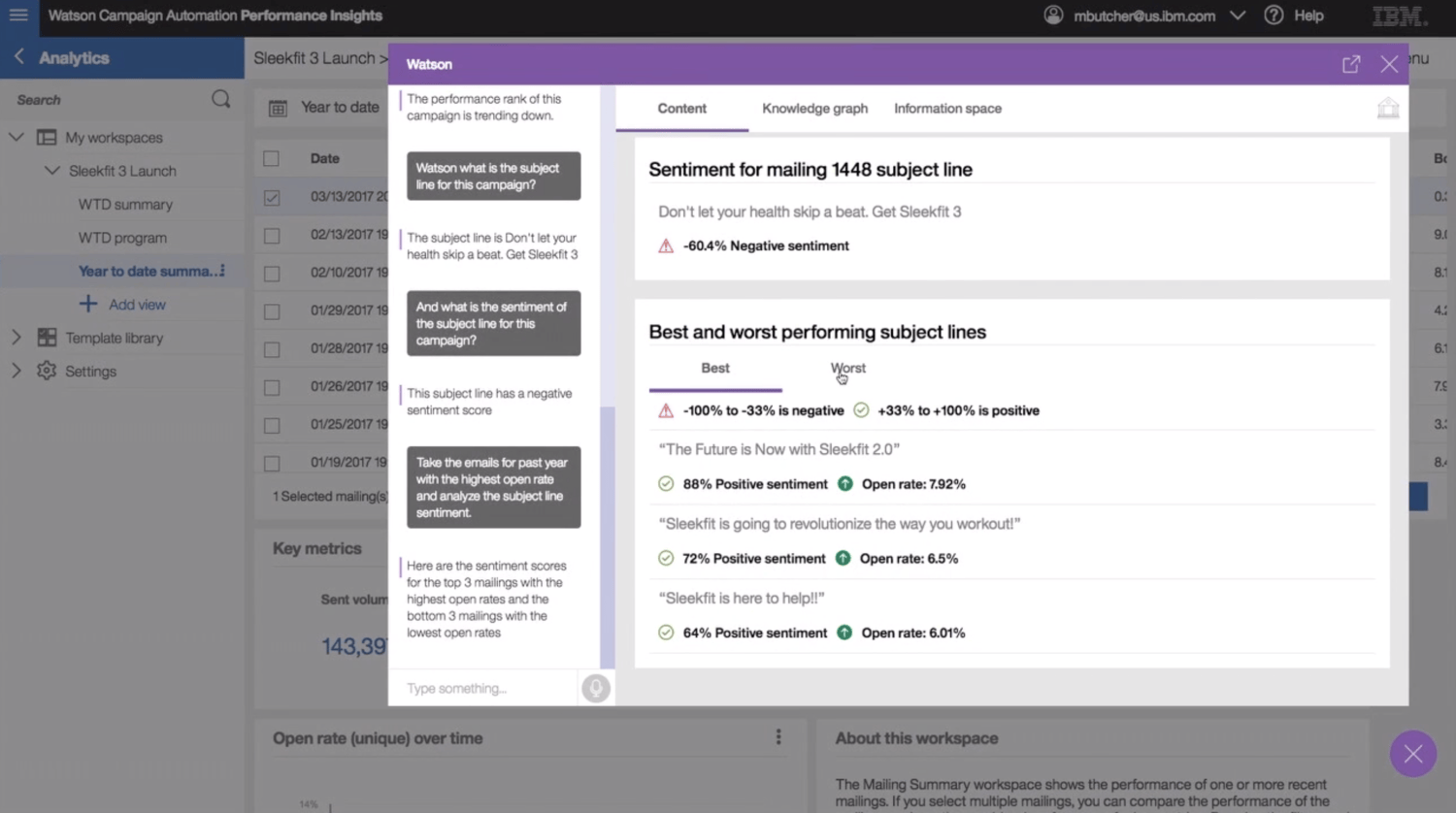
The visible one was Watson Marketing Assistant, where marketers could query campaign data in plain English. We got v1 onto the 2016 Amplify main stage in 90 days, shipped in 2017, and it lived on as Acoustic Marketing Assistant after IBM sold the business.
Program Director, UX Research2017–2020
Ran UX research for IBM Cloud as they built out a public cloud product.
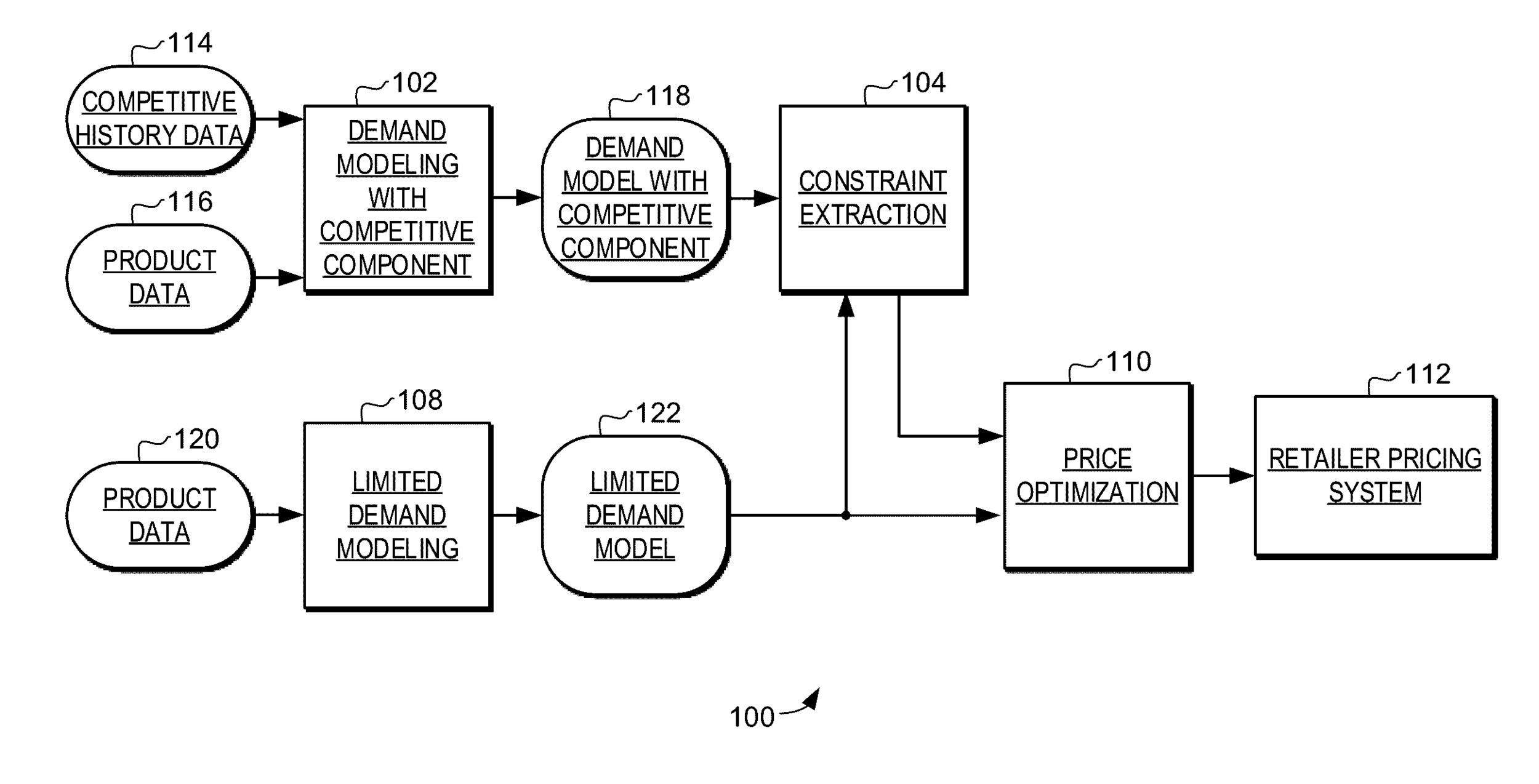
US patent 9,842,297.
Revionics
Senior Manager, Data Science2012–2015
Moved to the vendor side at Revionics, running retail price optimization implementations and later the data science team. Most of the leverage came from finding new ways to use data the product already collected.
When a client switched to matching competitors' prices, our software had nothing left to optimize. I rebuilt price elasticity with competitor prices as an input. They let the model price 59% of their revenue again and renewed.
Demand with and without switching.
FreshDirect2009–2012
Joined the New York online grocer before it had a pricing team and put in their price optimization system solo over four months of 80-hour weeks. Once it paid off I hired a team and expanded optimization to produce, meat, and fish, winning DemandTec's 2011 Business Enablement Award.
Earlier on the client side, I started on the Circuit City sales floor selling TVs, moved onto pricing, and learned a lasting lesson on an Oracle DB running on a Compaq ProLiant: more data is always better, even when storage makes everyone cringe. I also built a global analytics function at Estée Lauder pulling transactional data into decision support.
Elsewhere
Physics
I'm an amateur, mostly drawn to quantum foundations and the Bell test experiments showing the universe is not locally real (Clauser, Aspect, and Zeilinger's 2022 Nobel).
Given the time, I'd go back for Columbia's MA in the Philosophical Foundations of Physics. I wrote about some of this in Curiosity is not uniquely human.
Walking the Landscape
An interactive 3D project on cosmology: the Higgs field, dark energy, and the string theory landscape.
You walk a hillside in fog, seeing only the path behind you. When the fog lifts, the hills shift while your path stays fixed.
Erdős problems
Using AI provers to formalize Erdős problems in Lean: machine-checked proofs of known results for problems 304 (Egyptian fractions) and 867, plus a statement fix for problem 769.
These are known results verified by Lean's kernel, not new solutions, and no mathematician has reviewed them.
Side projects
Running Conway's Game of Life backwards by pairing a SAT solver with a neural network to guide the search.
Reproducing the experiments from Anthropic's paper on introspection in language models.
Next: testing whether a small model can reason in an internal loop instead of writing chain-of-thought text.
Writing
I went to school for technical writing, which is pretty left field for where I ended up. I write on Substack about AI and building products with it.